|
This model fell into the category of "I'll
build it because no one else will have one". In 1995 my wife and I were on
the last day of a fantastic 3 week trip to Northern Italy on business and on the
last day I finally had a chance to wander around Milan - home of fantastic red
wine, even better Northern Italian food, and without a doubt, home to the best
legged women in the world - most in short skirts, but that's another review.
I stopped in one of Milan's hobby stores, Focchi
Modellisimo (How come none of our hobby stores have such exotic names ?) and
found a number of resin kits in both 1/72 and 1/48 scale by a company called P.D.
Models. I wavered between two kits, a 1/48 Scale G.91 variant (I don't remember
which) and a 1/48 kit of the Italian - Brazilian joint development AMX. Now the
AMX isn't the hottest or sexiest thing flying, but the kit looked to be pretty
good and the AMX is an active service aircraft that has not been kitted in 1/48.
I've always liked the idea of having something in my display cabinet that no one
else has so I negotiated the price (with my wife, not the store) and purchased
the kit.
Examining the kit back at the hotel,
it is cast in a bunch (hey I built the thing 4 years ago and don't remember the
parts count) of the standard beige resin parts. Among them are parts making up a
nicely detailed cockpit (the MB ejection seat was particularly nice) and some
air to air and air to ground ordnance that was not fully casted. The wings and
empennage were all one piece castings with nicely scribed lines (they did need
some rescribing in places to keep them consistent), while the fuselage consisted
of three castings. The nose section was casted as one piece with the area for
the cockpit hollowed out, while the remainder was casted in two sections, a main
section from the intakes to ~2" shy of the tail, and a tail cone that mated
to the rear of the center section.
Assembly of the kit was rather
straightforward given the number of single piece castings. Getting the tail cone
to match the center fuselage section required more than a little elbow grease,
milliput and mild profanity. Fit between the nose and center section was equally
tricky but not brain surgery. Avoiding the see through effect on the jet intakes
was a stretch but I made do by inserting copper tubing from the inside of the
fuselage casting and flaring the ends until they somewhat matched the shape of
the intakes. I then cut the tubing and blanked it with card. Finally, by fairing
in the tubing with milliput I got pretty close to a smooth even intake
trunk. The single piece wings were located and then match drilled for
1/8" dia brass tubing to be used as an attachment aid. The wings were then
faired in with milliput.
AMX's are not known for their overly
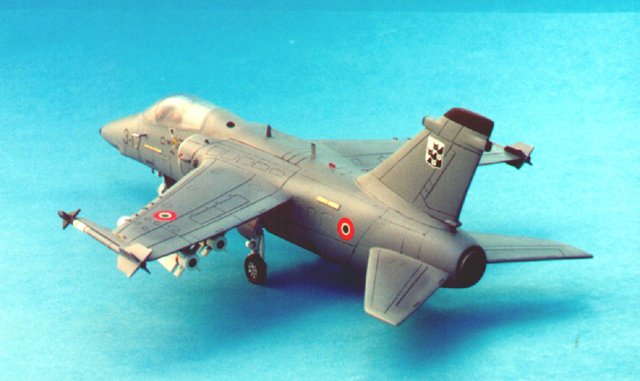
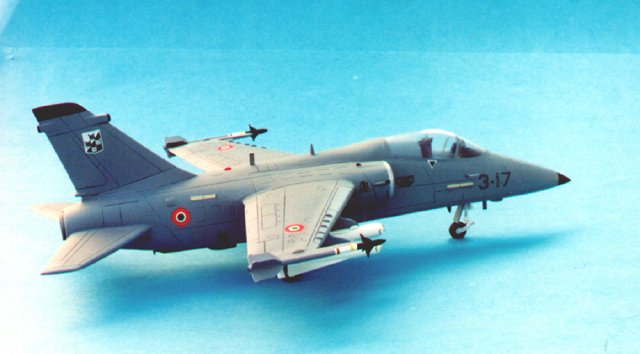
colorful paint schemes, and I took some liberties with mine in using some
countershading on the wing panels. The decals supplied with the kit went on
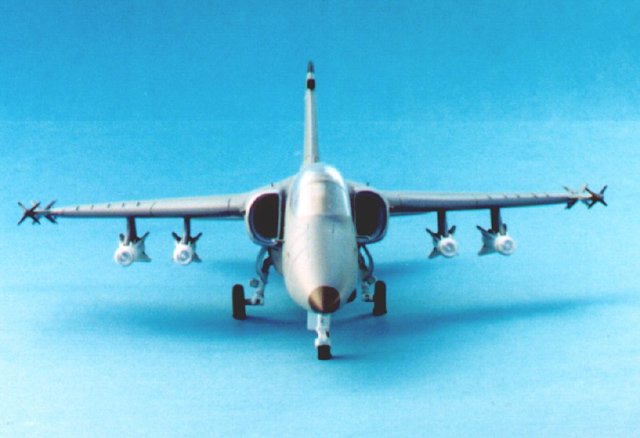
nicely. I finished the kit with some Mavericks and Sidewinders from the Hasegawa
weapons set to give the AMX a close support - anti-armor look. The biggest
challenge (it usually is for me) was getting the vacuformed bubble style canopy
faired into the nose.
All in all, the P.D. Models kit
built up into a nice looking replica of the AMX. I did not measure the model to
check dimensions (I just don't) so I can't speak to its accuracy, but it does
look like an AMX to me. I have seen some other P.D. Models kits on the Meteor
Productions Tables at the Nats, but I've never seen the AMX anywhere other than
in Milan. Among the references I used were a number of Aviation Leak articles
and an issue of World Air Power Journal that had a feature on the AMX. I still
have all of the reference material so contact me if you're looking for more info
on the Pocket Tornado.
My thanks to my
wife for allowing the review sample.
Todd
|