|
History:
The Dornier Do 335 'Pfeil' was the
brain child of Prof Dr Claudius Dornier. By the mid-1930's. he saw
the possibility of using this concept to power a high speed fighter. To
that end Ulrich Hutter was commissioned to design a small test bed for the
arrangement. Designated the Goppingen Go 9, and built by Schempp-Hirth, the
test bed featured a pencil thin fuselage containing a 59.6Kw Hirth HM 60R
engine. The Go-9 attained a speed of 137mph.
The first prototype Dornier Do 335
displayed remarkably good handling characteristics despite its
unconventional appearance and configuration and it's turn radius in
particular, was significantly better that expected. The aircraft did
porpoise and snake at high speed, but did not sufficiently dampen the spirits
of the Rechlin test pilots. Development was remarkably rapid, but production
was slow to get started. Fourteen prototypes were eventually completed
and flown together with ten Do335 A-0s, eleven Do335A-1s, and a pair of Do
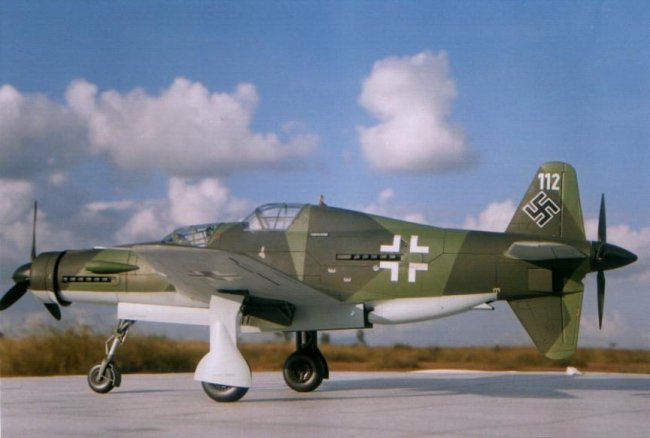
335a-12 trainers... one of which, no. 112 is the subject of this
article. Fifteen more were in final assembly when US forces over ran
Dornier's Oberpfaffenhofen plant. Among other unique features of this
aircraft, one of the most notable is the ejection seat (only the second
production type after the Saab J21). German pilots told of how,
during the test programme, two aircraft crashed and their pilots were found
still in the cockpit but with their arms missing. This was supposedly due to
the too firm grip being taken on the handles, which first jettisoned the
canopy before the seat could be fired out. Despite of its teething
problems the Pfeil proved to be a sound design with no major faults.
 |
| The
second production Do-335A-0 wears werk-nr 102 on its tail. To the
RLM, the aircraft was know as Project 231, and to its test pilots it was
the 'Pfeil' (arrow). But its prominent nose saw it dubbed '
Ameisenbar' (anteater) by its crews. This aircraft was eventually
shipped to the USA for evaluation.) |
|
Click on images below to
see larger images |
 |
 |
The Kit:
The fit was excellent, and hardly any putty
was ever used. The kit was built OOB, and posed no problems of any
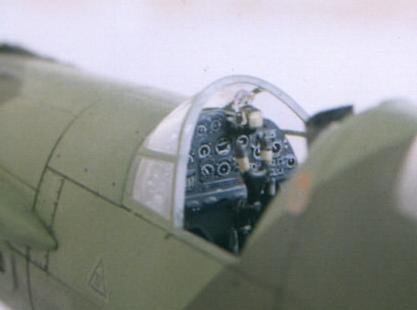
kind. The instrument panel decal was used and hand painted around
the dials to bring out the details. The major problem arose with
the splinter camo colours. Different illustrations show
different shades. So I mixed up my own shades of lime
and dark green to match a picture from 'Warplanes of the Luftwaffe'. Here in
India we don't get modeling clear matte, so the decal's silvered a bit.
No extensive weathering was done as most of these a/c's clocked very few
hours. All in all a great kit with few hassles!
Avinash
|
|