|
The Wiebault 7
series of French fighters was in many ways ahead of it's time- full metal
construction with a corrugated skin surface, as well as a triple(!) banked
inline lorraine engine- it was never used in great numbers by the French
themselves but served with many of the smaller airforces of the world-
among them Paraguay, Poland and Chile- with the Chilean ones having been
built by Vickers with a Jupiter radial engine. As a fighter it was
marginal at best- but still served long and honorably in many of these
smaller air forces until the mid thirties.
The kit itself
is a bit of a mystery to me- I think it may be a (very) early Dujin resin
kit- soft tan resin , lots of air bubbles and the most interesting copper
flat wire included in the package to be used for the struts. All in all
not quite Tamiya like quality but a fine starting place if you're in the
mood for a little extra work. The only usable parts in the kit are
the basics- the fuselage sides, parasol wing and tailplane
assembly.
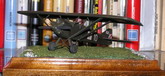
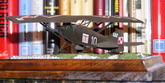
Click on
images below to see larger images
After sanding
the rather vague detail off the fuselage and thinning the somewhat thick
wings I separated all of the bits that move- rudder, elevators and such
-adding hinge posts and rounding the front edge of each moving piece.
After scratch-building a rather generic interior and mating the fuselage
halves it's time for the major challenge of this kit- restoring the
fuselage and wing detail-with Tamiya tape to the rescue! One new
knife blade, lots of stripped tape and 4 coats of heavy primer later
an acceptable level of corrugated skin detail is restored. Next I
soldered together a landing gear and the center N strut assembly out of
the original copper strut material-the copper itself was soft enough to
file a bit of an airfoil shape into it - and by using epoxy to attach the
wing and the landing gear assemblies to the fuselage it was now solid
and durable enough to work with during final painting and assembly.
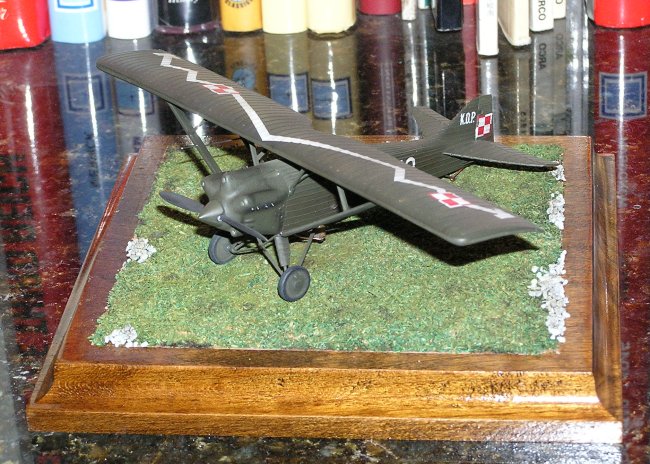
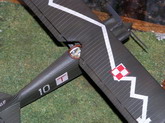
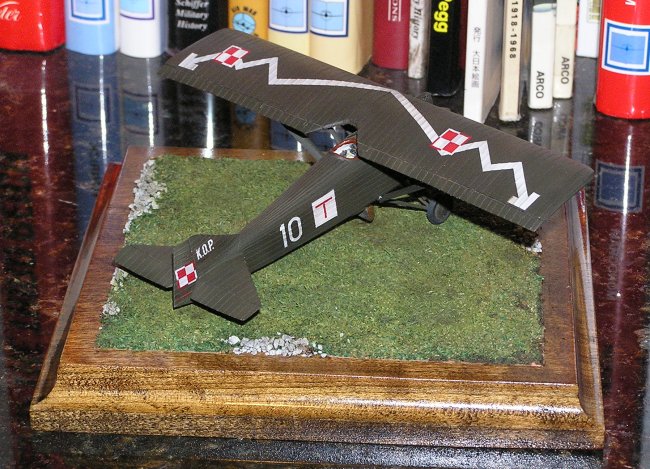
Initially I truly wanted to do a plane from the Gran Chaco war-but the
complete absence of appropriate decals in my stash caused the shift
to an early polish version of which I had most of the decals at hand.
The unit (?) symbol T was the only one that had to be masked and
painted-the rest are from an In-Tech sheet or two. After painting the
complex paint scheme of dark green everywhere, decaling and some light
post-shading with flat clearcoat mixed with black paint, it was time to
hang all those interplane strut assemblies- now newly made from contrail
strut material -attached to the kit with fine wire to give them the
separation from their attachment points that the original seemed to have,
add exhausts made from hypodermic stock, a few more wire details and
you're there!
My thanks to
whomever made this kit of a rare aircraft that will probably never be made by a
more mainstream company-please keep them coming!
Keith
Click on
images below to see larger images
|