Cutting Edge Modelworks

1/32 Red Baron's Tri-planes Fokker Dr.1 Part 1 decal sheet

Product # CED32066 for $14.99

Product Article by Steve Bamford on July 12  2006


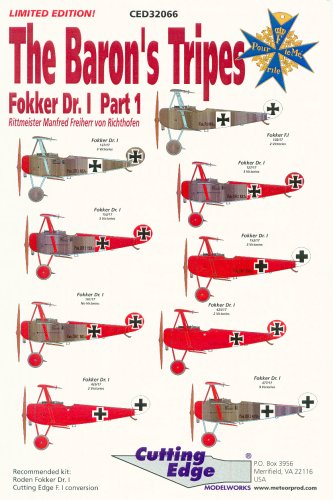
This new decal sheet from Cutting Edge Modelworks includes markings for 9 different Fokker Dr.1's.  

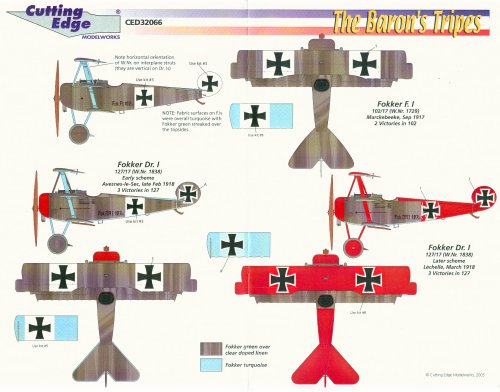
The first aircraft is a Fokker F.1 102/17 (W.Nr. 1729)  Marckebeeke, in Sept 1917.....2 victories in 102.  The paint scheme is a fabric that is overall Fokker green streaked over clear doped linen and Fokker Turquoise on the underside.    The rudder is white with a black cross and the wings have white areas with a black cross (the white areas will have to be painted).  This aircraft was flown by Manfred von Ricthofen and Ltn. Kurt Wolff.  Manfred von Ricthofen scored his 60 and 61st victory in this aircraft and Ltn. Kurt Wolff died in this aircraft when he was shot down on Sept 15.  This was one of 2 pre-production aircraft allocated to front line units for evaluation and it lasted 2 /12 weeks at the front before being destroyed.

The second aircraft is a Fokker Dr.1 127/17 (W.Nr. 1838) Avesnes-le-Sac in late Feb 1918.  This aircraft had 3 Victories in 127.  This is the early scheme on this particular aircraft. The paint scheme is a fabric that is overall Fokker green streaked over clear doped linen and Fokker Turquoise on the underside.    There is a black cross with a white outline on the tail and the wings have white areas with a black cross (the white areas will have to be painted).  The forward engine cowling ring is bright red.  Manfred von Ricthofen scored 3 victories in this aircraft.

The third aircraft is a Fokker Dr.1 127/17 (W.Nr. 1838) Avesnes-le-Sac in late Feb 1918.  This aircraft had 3 Victories in 127.  This is the early scheme on this particular aircraft.  The paint scheme is a fabric that is overall Fokker green streaked over clear doped linen and Fokker Turquoise on the underside.  The top of the wings and rear half of the fuselage is bright red.  There is a black cross with a white outline on the tail and the wings have lighter red areas with a black cross (the light red areas will have to be painted).  The forward engine cowling ring is bright red.

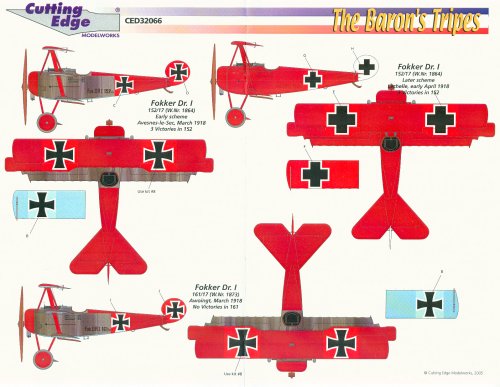
The fourth aircraft is a Fokker Dr.1 425/17 (W.Nr. 2009) Lechelle in late March 1918.  This aircraft had 2 Victories in 425.  This is the early scheme on this particular aircraft.  The paint scheme is red over all on the top and bottom.  There is a black cross with a white outline on the tail and the wings have lighter red areas with a black cross (the light red areas will have to be painted).  The wing struts are bright red.  This is Manfred von Ricthofen's final aircraft and the one he was shot down in on Apr 21 1918......when it was painted in the later shceme.  He scored his 2 final victories in this aircraft on April 20 1918.

The fifth  aircraft is a Fokker Dr.1 425/17 (W.Nr. 2009) Cappy in April 1918.  This aircraft had 2 Victories in 425.  This is the later scheme on this particular aircraft.  The paint scheme is a fabric that is overall Fokker green streaked over clear doped linen and Fokker Turquoise on the underside.  There is red on the top of the wings and tail.  There is a black cross on the white tail and the wings have lighter red areas with a black cross (the light red areas will have to be painted).  The forward engine cowling ring is bright red as is the wing struts.  This is Manfred von Ricthofen's final aircraft and the one he was shot down in on Apr 21 1918.  He scored his 2 final victories in this aircraft on April 20 1918.

The sixth aircraft is a Fokker Dr.1 152/17 (W.Nr. 1864) Avesnes-le-Sac in March 1918.  This aircraft had 3 Victories in 152.  This is the early scheme on this particular aircraft.  The paint scheme is a fabric that is overall Fokker green streaked over clear doped linen and Fokker Turquoise on the underside.  The top of the wings and rear half of the fuselage is bright red.  There is a black cross with a white outline on the tail and the wings have lighter red areas with a black cross (the light red areas will have to be painted).  The forward engine cowling ring is bright red.  This was one of Manfred von Ricthofen's favourite aircraft and he  scored 3 victories in this aircraft.  This aircraft was destroyed during WW2.

The seventh aircraft is a Fokker Dr.1 152/17 (W.Nr. 1864) Lecelle in early April 1918.  This aircraft had 3 Victories in 152.  This is the later scheme on this particular aircraft.  The paint scheme is red over all on the top and bottom.  There is a black cross on the white tail and the wings have lighter red areas with a black cross (the light red areas will have to be painted). 

The eigth aircraft is a Fokker Dr.1 161/17 (W.Nr. 1873) Awoingt in March 1918.  The paint scheme is a fabric that is overall Fokker green streaked over clear doped linen and Fokker Turquoise on the underside.  The top of the wings and rear half of the fuselage is bright red.  There is a black cross with a white outline on the tail and the wings have lighter red areas with a black cross (the light red areas will have to be painted).  The forward engine cowling ring is bright red.  This aircraft was one of  Manfred von Ricthofen's spare aircraft and he scored no victories in it.

The ninth aircraft is a Fokker Dr.1 477/17 (W.Nr. 2103) Lechelle in March 1918.  This aircraft had 9 Victories in 477.  The paint scheme is a fabric that is overall Fokker green streaked over clear doped linen and Fokker Turquoise on the underside.  The top of the wings and the tail is bright red.  There is a black cross on the white tail and the wings have lighter red areas with a black cross (the light red areas will have to be painted).  The forward engine cowling ring is bright red.  Manfred von Ricthofen's scored more kills in this aircraft than any other aircraft.....9 victories.  

Click on images below to see larger images of the instruction sheets

The instructions are clear and include colour drawings to assist in decal placement.  There is also 3 pages of text including information about most of the aircraft.

A very nice decal sheet and will be helpful for anyone building a big 1/32 Fokker Triplane flown by the Red Baron.

I would like to thank Cutting Edge Modelworks for providing me with this review sample.

Steve

Photos and text © by Steve Bamford